Published on07/08/2026
Getting the size wrong is the most common mistake when buying a ring online, and the most expensive one: every resize thins the shank a little, and some setting styles cannot be resized at all.
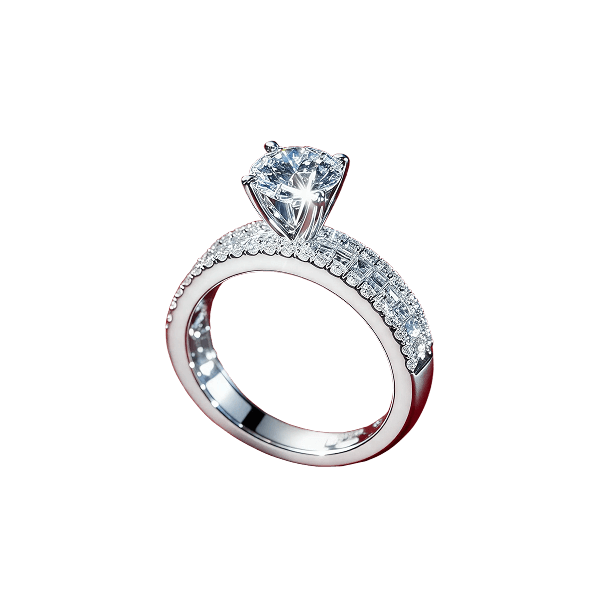
First thing to know: fingers do not hold one size. They are smallest in the early morning after the body has rested, and largest in the evening after a day of activity. The gap between the two can be a full size. Cold weather constricts blood vessels and shrinks the finger; heat and humidity swell it. A hand measured in a Da Nang summer and the same hand in a Hanoi winter give two different numbers.
So measure in the LATE AFTERNOON, with your hands at normal temperature. Do not measure straight after exercise, after carrying something heavy, after drinking, or after coming in from the cold. All four give a wrong number, and each one wrong in a different direction.
The simplest method needs one piece of thread and a ruler. Wrap the thread around the base of the finger, snug enough not to slip but loose enough to rotate, mark where the ends meet, then lay it flat and measure the length in millimetres. That is the circumference. Divide by 3.14 for the diameter and check it against a size chart. Measure three times on three different days and take the number that repeats — a single measurement is easy to get wrong.
Do not use elastic or wire. Elastic stretches, so you will unconsciously pull it tighter than reality and get a small number. Wire does not follow the shape of the finger and gives a large one. Ordinary cotton thread is the most accurate thing most people have at home.
Here is a detail most online guides skip: the KNUCKLE. The ring has to pass the knuckle before it reaches the base of the finger. For many people the knuckle is considerably wider than the base. If you size to fit the base snugly, the ring will not go on. Measure both points, take the larger number, and accept that the ring will sit slightly loose at the base — a jeweller can add two small beads inside the shank to stop it spinning.
When your measurement falls between two sizes, always take the LARGER one. The practical reason: sizing a ring up is much easier than sizing it down, and a tight ring cannot be removed when the finger swells — which happens more often than people expect, especially on flights and during pregnancy.
One note on wide bands. Anything from 6 mm up wears tighter than a slim band of the same nominal size, because there is more contact area. If you are used to a 2 mm ring and are now buying an 8 mm one, go up half a size.
If you are buying an engagement ring and cannot ask, a few discreet methods actually work. Borrow a ring she already wears on the CORRECT ring finger — a ring worn on another finger is a different size — and either trace the inner circle on paper or press it into a bar of soap for an impression. Do not ask her best friend: in our showroom experience, a best friend guesses correctly about as often as a coin toss.
Finally, ask about the resizing policy before you buy. At PhuocSwiss, rings made in our own workshop get one free resize within two sizes. But an eternity ring set all the way round cannot be resized at all — with that style, measuring wrong means starting again.