Published on12/09/2026
Almost everyone who starts researching engagement rings meets the same number: three months salary. It gets repeated so often that it sounds like an old tradition, or an industry standard.
It is neither. It was a line in a De Beers advertising campaign launched in the United States in 1938. And the original number was TWO months salary. It rose to three over the following decades, as sales targets rose. There is no basis behind it beyond that.
Knowing that, the real question is how to set a sensible budget. The approach I have found works best after years at the counter is to reverse the usual order. Do not choose a stone and then work out how to pay for it. Decide the number first, say that number plainly to the seller, and then choose the best stone within it.
What you spend on an engagement ring should be an amount you can pay without borrowing, and without eating into money already set aside for the wedding or for moving in together. A beautiful ring that comes with debt is a poor start, and the person receiving it almost always feels that way if they know.
On real numbers at the showroom, most engagement ring customers at PhuocSwiss land between 30 and 80 million dong for the complete ring. Some spend 15 million and some spend 300 million, and both are entirely normal.
Within that common range, the balance point we usually recommend is: around 0.5ct, F to G colour, VS2 clarity, Excellent cut, in an 18K white gold setting. Large enough to read clearly on a hand, white enough that nobody sees a tint, clean beyond what the eye can detect, and above all cut well enough to throw real light.
Now the most useful part: the ORDER TO CUT BACK when the budget does not reach. Cut CLARITY first. VS2 down to SI1 saves meaningfully and the eye still sees nothing — just ask where the inclusion sits, because near the girdle it disappears under a prong.
Cut COLOUR second. F down to H, and if the setting is yellow or rose gold you can go as far as J, because the metal casts its colour onto the stone and masks any faint tint. This is where people most often overpay.
Cut CARAT third, and cut it cleverly: aim just below a round mark. 0.92ct instead of 1.00ct saves around twenty percent while the diameter is only two tenths of a millimetre smaller — nobody can see it.
NEVER cut the CUT. It is the only C that decides whether the stone has fire, and the only one that cannot be fixed later. A smaller stone cut Excellent always looks more expensive than a larger one cut Fair.
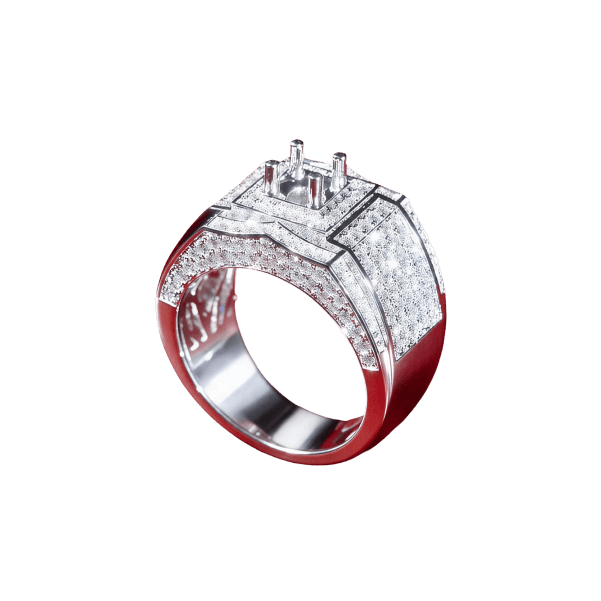
A few more levers are worth knowing. A halo setting makes the centre stone read about one size larger — the cheapest way to buy visual presence. Oval and pear shapes present more table area than a round at the same weight. And buying a semi-mount and choosing the stone separately lets you upgrade the centre later without remaking the ring.
Finally, do not forget the costs outside the stone price: setting labour, engraving, the box, and insurance if you want it. None are large, but together they can push a tightly calculated budget over.