Published on31/07/2026
The four Cs are the common language of the jewellery trade: Carat (weight), Colour, Clarity and Cut. Every grading report, every price list and every negotiation turns on these four letters. Understanding them will not make you an expert, but it is enough to stop you paying for things you cannot see.
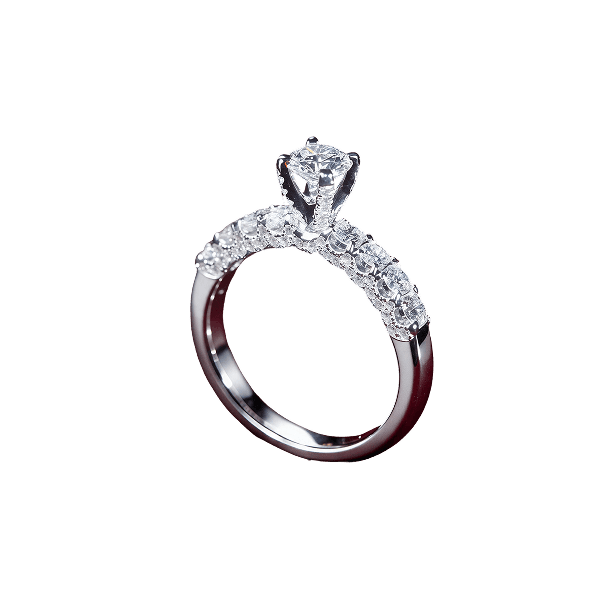
Carat is weight, not size. One carat is 0.2 grams. Two stones of identical carat weight can look noticeably different in size if one is cut deep — that weight is hidden below the girdle, where it does not widen the table and the eye never sees it. When comparing two stones of the same weight, ask for the table diameter in millimetres. That is the number that decides how large the stone reads on a hand.
Colour is graded D to Z by how much yellow tint the stone carries, with D being completely colourless. The gap from D to J sounds enormous, but grading labs judge colour with the stone FACE DOWN on a white tray, under standardised light, against a set of master stones. Nobody wears a ring in that position. Once the stone is set and facing up, reflected light masks most of a faint yellow tint.
What that means at the counter: from D to G, almost nobody can tell the difference by eye unless the stones are side by side. H to J still reads white on the hand, just slightly warm under close inspection. Only from K down does the yellow become obvious. One exception worth remembering: yellow gold and rose gold settings cast their own colour onto the stone, so with those metals you can drop to J or K without anyone noticing, and save a meaningful amount.
Clarity measures internal inclusions and surface blemishes, on a scale from FL (flawless) down to I3 (inclusions obvious to the naked eye). The critical detail: the entire scale is graded under 10x MAGNIFICATION. A VS2 grade means inclusions are difficult to find at 10x — which means they are entirely invisible without a loupe.
So from VS2 upward you are paying for the certificate, not for anything you can see. The price gap between VVS1 and VS2 can reach 25 percent, and not one guest who walks into the room will spot the difference. Even SI1 is often eye-clean, depending on where the inclusion sits — under a prong and it disappears entirely. The only question worth asking is where the inclusion is, not what the grade says.
Cut is the one C fundamentally unlike the other three, because it is the only one decided by HUMAN HANDS. Carat, Colour and Clarity are what the stone brought up out of the ground. Cut is what the cutter made, and it is what decides whether the stone has fire.
The mechanism is simple. A diamond does not generate light; it takes light in from above, bends it inside the stone, and returns it to the eye. Cut too shallow and light passes straight through the bottom and escapes, leaving the stone dark in the centre. Cut too deep and light leaks out of the sides instead. Only within a fairly narrow band of angles does light reflect internally and bounce back up through the table — that is fire.
The practical consequence: a D colour VVS1 stone with a Fair cut will look duller than an H colour SI1 stone cut Excellent. And everyone can see that difference, no loupe required.
So when the budget is tight, cut back in this order: Clarity first (VS2 down to SI1), then Colour (F down to H), then Carat (1.00ct down to 0.92ct). Protect the Cut at Excellent at all costs. It is the only way an affordable stone still looks expensive.
A final word on the report. A grade only means something alongside the name of the lab that gave it. GIA grades strictest; IGI typically runs one to two grades more generous on Colour and Clarity for the same stone. Comparing IGI specs against GIA specs on price is comparing two different rulers, and you will always conclude the IGI stone is cheaper when in fact it is not.