Published on15/08/2026
The setting decides three things at once: how large the stone reads, how durable the ring is, and whether it is comfortable to wear every day. Choosing from a photograph while ignoring the last two is the fastest route to a ring that only comes out on special occasions.
A solitaire is a single stone, usually in four or six prongs. It is the safest choice and the best-selling style in every showroom in the world. The reason: it does not obstruct the stone, light enters from every direction so the diamond is as bright as it can be, it is easy to clean, and it suits every hand. If you are undecided and short on time, a six-prong solitaire will never be wrong.
The difference between four and six prongs is worth thinking about. Four prongs expose more of the stone and make a round diamond read slightly squarer, which reads slightly larger. Six prongs hold more securely — lose one and five remain, whereas losing one of four is a genuine emergency. For stones from 1ct up, or for an active wearer, six prongs is the level-headed choice.
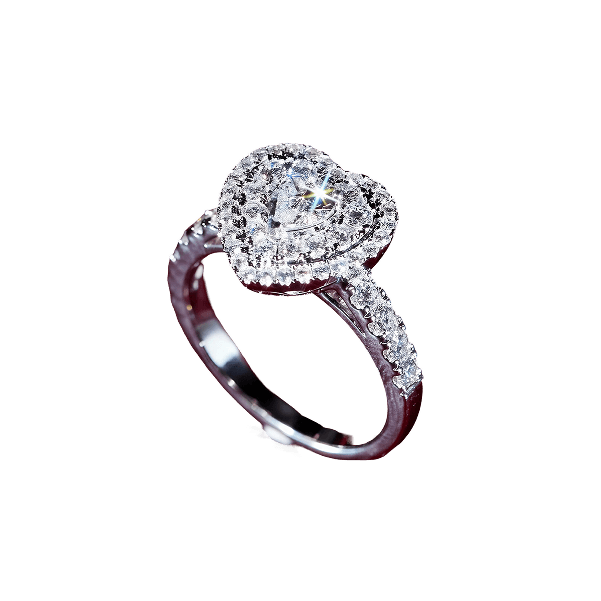
A halo is a ring of small stones encircling the centre stone. The visual effect is powerful: a 0.5ct stone in a halo reads about the same as an 0.8ct on its own. If the budget for the centre stone is limited but you still want the ring to look substantial, this is the most cost-effective route. A double halo pushes the effect further still.
But a halo has three costs. First, many small stones mean many small prongs, and every small prong is a point that can loosen — the ring needs periodic checking. Second, the gap between the halo and the centre stone traps lotion and soap very quickly, and without regular cleaning the stone visibly dulls. Third, a halo setting can barely be resized, and the centre stone cannot be swapped for a different size because the halo diameter is fixed.
A three-stone setting places a centre stone between two side stones, usually explained as past, present and future. Leaving the symbolism aside, it is the style that covers the most width on a hand for a given budget, and it looks excellent on long fingers. On short fingers it easily reads as swallowing the whole segment.
A bezel wraps a rim of metal fully around the edge of the stone. It is the MOST SECURE setting there is: no prongs to snag on knitwear or hair, no prongs to loosen, and the girdle of the stone is completely protected. If the wearer is a doctor, a nurse, a chef, a kindergarten teacher, or anyone who works with their hands all day, a bezel is the right answer. In exchange, the metal rim blocks light entering from the sides, so the stone is noticeably less lively than in a solitaire, and the rim makes it read a little smaller than it is.
There is one more factor that rarely gets mentioned but shapes daily wear: SETTING HEIGHT. A high setting lifts the stone off the finger, lets light in from below, and makes it sparkle considerably more. But a high setting also catches on everything, snags on pockets, and tips sideways when worn alongside a wedding band. A low setting is more durable, more comfortable, easier under gloves, and slightly less brilliant.
The most practical way to choose: think about an ordinary day in the life of the person who will wear it, not about the proposal. Do they type for eight hours? Carry a small child? Wash dishes every evening? Train four times a week? Answer those and the list of suitable settings usually narrows to one or two, and only then is choosing on looks alone safe.
Finally, if the plan is to stack it with a wedding band later, try that at the counter now. A high setting, or one with a protruding basket, leaves a gap between the two rings, and closing that gap means a contoured wedding band — something to commission alongside the engagement ring, not two years afterwards.