Published on02/09/2026
Buying a complete ring with the centre stone already set is the familiar route, and for many people it is the right one. But there is another approach that more and more customers choose: buy the setting empty and choose the stone separately.
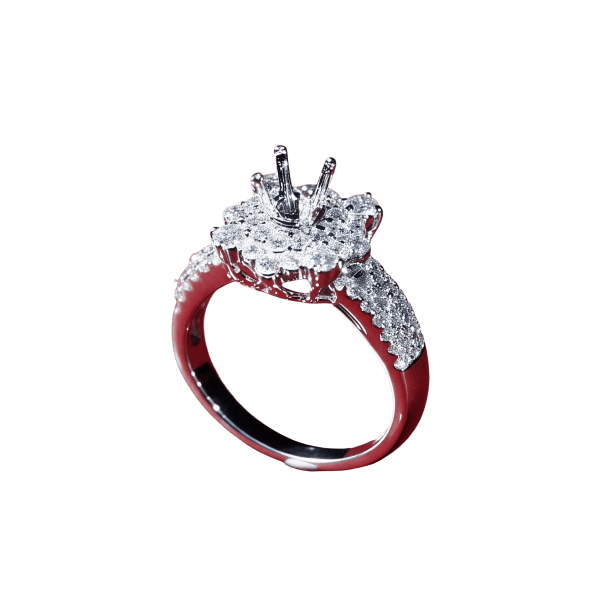
An empty setting, called a semi-mount, is a ring finished in every respect — the shank, the head, and all the accent stones if there are any — with only the centre position left open. You buy that first, choose the stone afterwards, and the jeweller sets it.
The biggest advantage is that it SEPARATES TWO DECISIONS. Choosing the ring design is an aesthetic decision, driven by the wearer taste and the shape of their hand. Choosing the stone is a financial decision, driven by budget and by how much you care about the 4Cs. Collapsing both into a single choice usually means compromising on both: taking a ring that looks acceptable because the stone was affordable, or the reverse.
The second advantage is upgradability. The same setting can hold a 0.5ct today and a 1ct five or ten years from now without remaking the ring. Many couples do this deliberately: buy a good setting from the start with an affordable stone at the wedding, then upgrade the centre for a tenth anniversary. It stays the same ring, just with a larger stone.
The third advantage is one few people consider: you get to examine the stone BEFORE it is permanently set. Buying a complete ring means the stone is already in its prongs — you cannot inspect the girdle, cannot properly match the laser inscription against the report, and cannot compare it against several others under the same light. Buying loose lets you do all of that.
There are real caveats, though. First and biggest: if the setting already has a halo, the halo diameter is FIXED. The centre stone has to match it, anything much off will not fit, and that erases the upgrade advantage above. If you are buying a semi-mount specifically to trade up later, avoid halos and choose a solitaire or a head with adjustable prongs.
Second, ask exactly what carat range and what cut shape the setting accepts. A head made for a round brilliant will not take an oval or a princess. A head designed for 0.7 to 0.9ct can sometimes take a 1.0ct, but the prongs have to splay and the proportions look wrong.
Third, setting labour and prong adjustment are separate charges, not included in the price of the mount. The amount is small, but ask upfront so it is not a surprise. And have the SAME workshop do both jobs if you can: the workshop that made the setting understands it best, and if the stone loosens later there is nobody to pass the blame to.
Fourth, ask for a check after setting. Setting a centre stone means splaying the prongs open and closing them again — an operation that fatigues metal. A good jeweller tests security by shaking the ring for a rattle and inspecting every prong under a loupe before handing it over. Just ask directly whether they do that step.
At PhuocSwiss we sell semi-mounts as their own product line rather than as stock waiting for a stone, and we state the carat range and cut shape each one accepts. Customers who buy a setting here and bring a stone from elsewhere are entirely normal and we are happy to set it — we simply re-examine the stone first, and we will say plainly if it does not suit the mount.