Published on09/09/2026
This question comes up almost daily at the counter, and the short answer is: yes, a lab-grown diamond is a real diamond. But that short answer leaves out nearly everything you actually need to know.
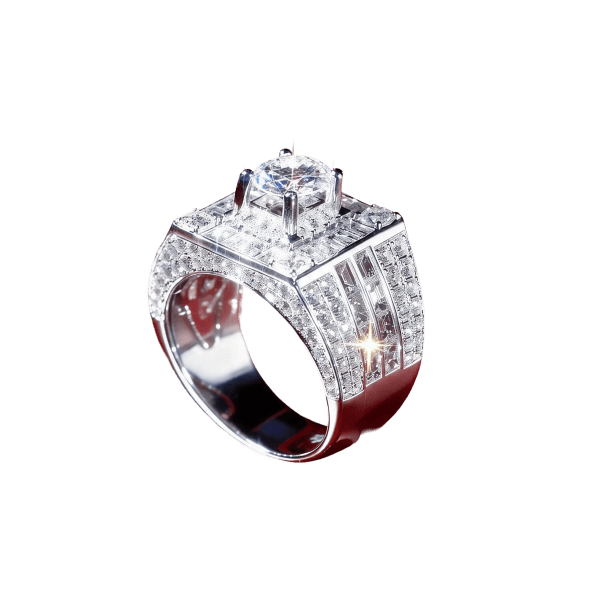
Materially there is no dispute. A lab-grown diamond has the same carbon crystal structure, the same 10 on the Mohs scale, the same refractive index, the same dispersion. It is not a simulant like cubic zirconia or moissanite — those are entirely DIFFERENT materials that merely resemble diamond. A lab-grown diamond is diamond; only its birthplace differs.
Two technologies are in use. HPHT reproduces the temperature and pressure conditions found underground. CVD deposits carbon from a vapour phase onto a seed crystal, layer by layer. Both produce genuine diamond, and both leave characteristic growth signatures that a lab can read with specialised equipment. The handheld diamond tester at a jewellery shop cannot.
Now the part that matters: PRICE. At identical 4C specs, a lab-grown stone costs 60 to 80 percent less than a natural one. For the same budget you get a noticeably larger stone — typically the difference between 0.5ct and 1.5ct, which is a difference anyone can see on a hand.
But there is a trend to understand before deciding. Lab-grown prices have FALLEN steadily for years as global production capacity has expanded. The stone you buy today may be considerably cheaper in three years. The consequence is that there is almost no buy-back market: shops do not want to take in stock whose new price is still dropping.
Natural diamonds hold value far better, though here too it needs saying plainly: they are NOT an investment. The gap between retail and buy-back price is already wide, so buying today and selling tomorrow is a near-certain loss. The difference is that a natural diamond retains some stable value across decades, and a lab-grown one has no such guarantee.
There is one more dimension often raised: environment and origin. Lab-grown diamonds involve no mining, and for many younger customers that is the deciding factor. It is worth knowing that growing diamonds consumes a great deal of electricity, so how clean it really is depends on the power source of the facility. Natural mining, conversely, has tightened traceability enormously since the Kimberley Process.
The blunt advice, by situation. If you are buying to wear, want the largest stone your budget allows, and are not thinking about resale — lab-grown is a sensible choice and there is nothing to apologise for. If you are buying an heirloom to pass down, or you intend to trade up later and want the old stone to carry value forward — buy natural.
A final note on disclosure. A lab-grown stone must be identified as such on the report and on the invoice; it may not be sold as natural. At PhuocSwiss we sell both and always state which on the receipt. If a seller hesitates when you ask directly whether a stone is natural or lab-grown, that hesitation is itself the answer.